Friday, 17 April 2015

What is the Cost of an Aerial Installation in Sudbury and Bury St Edmunds?


The most frequent question I get asked is “How much does it cost to have a TV aerial installed?” Looking at the various figures quoted on the web, especially from the national companies, you would be forgiven to think it should cost no more than about fifty quid!

However, many companies often tack on the extras and surcharges that include poles, brackets and cable. This is not evident in the advertised ‘from’ price. These add-ons are then often inflated taking the total cost far in excess of what we charge.

One national company whose price list we have seen advertises aerial installations for less than £50 + VAT. In reality the price for a new installation with 6ft pole, cable and brackets, comparable to our inclusive  £100 installation, is £145+VAT.  Look at the leap from the low ‘hook them in’ price, to the extras required for the majority of installations that are added on when the installer arrives. We are at least 20% cheaper than their prices and in some examples theirs are over double ours; really!

So the cheapest advertised price will usually be one of the most expensive. As a guide our aerial installation prices including all brackets, masts, cables etc and fully installed range from £100 to £165 with no added VAT depending on  type of aerial and fixings chosen. Recommendations on ‘best solution’ are given after a signal test is made with an approved spectrum analyser and you have been consulted.  Our customers are free to accept or decline our recommendations. All installation work has a  30 day money back guarantee.

Many companies distinguish between a call out charge and a labour charge. So, the glib banner proclaiming ‘NO CALL OUT CHARGE’ often means just that, no charge for being called out. The labour charge will still apply though even if the fault is not rectified. Let me make my position very clear!  If we cannot fix your problem then we make no charge whatsoever. This applies to both installations and repairs. 

Visit our web site  or call 01787 311057 or 01284 799042.

Friday, 25 April 2014

Digital UK issue Freeview TV guide update


DUK have issued notice that the Freeview TV guide is being updated on Wednesday, 3 September 2014 to create extra capacity for new services. As a result, Children’s and News channels will move to new channel numbers. The Children’s genre will move from LCN 70 to start at LCN 120 and the News genre will move from LCN 80 to start at LCN 130.
To update their guide viewers simply need to retune their Freeview TVs and digital boxes where equipment does not pick up the changes automatically. On-screen messages will prompt viewers to retune on or after 3 September 2014.
Viewers who don’t retune will not lose channels – services will remain accessible at their old numbers. However, Digital UK and Freeview recommend viewers retune from time-to-time to ensure they have access to all available services in their area.

(Live in Suffolk or Essex? Need any help? Why not give us a call...)

Tuesday, 11 February 2014

Big changes to European reception of UK TV via satellite?


Viewers in parts of continental Europe,
Scandinavia and the Mediterranean
begin to lose further UK free-to-air
channels as a result of the switch to new
satellite Astra 2E.


The BBC satellite move is part of a
second phase of moving TV and
radio services across to a new generation
of three satellites that will provide
the UK and Ireland with TV and radio services
via Sky and Freesat.All of the three new
satellites have a much tighter spotbeam,
specifically designed for the UK and Ireland.
The first phase took place in late 2012,
when Astra 2F went into service and the
first batch of UK free-to-air channels,
including standard definition Channel 5,
were lost across parts of Europe.

Additionally, the reports also indicate
where "sidelobes" around the main spotbeam
are found, and where "nulls" are found.

The best image to illustrate the reception
situation comes from Asia-Pacific satellite
website APSATTV.


This is a cross section of a typical satellite's
footprint on earth.(Don't take too much notice
of the dB numbers here for the following
information.)

The main lobe or the big hump in the middle
- in our case,the UK spotbeam - is over the UK,
Ireland and the low countries.To keep it simple,
the hump is where signal strengths are the best.
To the left (West) reception disappears into
the Atlantic.

To the right (south and east  into continental Europe),
as you go further to the edge of the main lobe,
reception drops off rapidly, and we go into a null.

In the case of Astra 2E, the satellite signal drops
off rapidly over southern France,where dish sizes
for UK TV increase rapidly south of Toulouse.
The same is true over Germany,where a new
East-West divide slices the country in two.

This "null" is, according to reception reports,
over Catalonia, parts of Northern Italy,Austria
and up through parts of the Czech Republic
into Eastern Germany.If you're right under
the null, even the biggest satellite dishes are
unlikely to help. Users in Catalonia have tried and
failed with a 3 metre dish!

Beyond the null are side lobes. You can see in
the picture above the side lobes represented by
a smaller "hump". Places such as Valencia,
Western Poland and Southern Sweden have
reported surprisingly good results on
smaller dish sizes.

Then we go into another null, as we move
further away from the spotbeam.
Southern Spain, for example, is badly hit by
this null. Gibraltar's Panorama website recently
reported that some local satellite installers couldn't
get a signal from sister satellite Astra 2F
(which has a practically identical spotbeam) even
with a 6 metre dish.

As we see in the picture,
a further - but weaker - side lobe comes
into play the further away we get.
This has allowed some in the Canaries to get
some reception with a 3 metre dish - but very
localised and patchy.

Side lobes mean that you can't just assume
that satellite dish sizes need to increase steadily
the further away you are from the spot beam.
In fact, there are distinct 'waves', with dish sizes
increasing near nulls and decreasing near side lobes.


Here's a satellite a footprint map for Astra 2E.
NOTE: dish sizes are designed to be
conservative.
 Some users will have very
professional set-ups with satellite receivers

containing sensitive tuners. Any slight anomalies
or shortcomings in satellite set-ups will have a major
affect in fringe areas.

Some smaller dish sizes might be able to pick
up some,but not all channels on the UK spotbeam.
Early reception reports suggest the "nulls" are
slightly further away from the spotbeam on
 lower frequencies:so some regional variations
of channels may be available, but not others.

In addition,the spotbeam appears to 'wobble' a bit.
As the drop-off around the spotbeam is
so sharp, it means reception can vary

greatly from hour to hour.Some user reports
show that they have lost BBC channels,
before regaining them for a while.
 A larger dish size will normally provide some
reserve when that happens, and also for when
the weather is bad.

Saturday, 16 November 2013

Internet Broadband via Satellite. The low down.
New website here

I supply and install Broadband via satellite for people who live in a rural area with no or very poor broadband connection. If this sounds like you then read on.

1. Satellite Broadband is for people who cannot get a good broadband service in their location.
Satellite broadband is deployable pretty much anywhere within the coverage footprint for a given
network (Tooway /SES/ Avanti), assuming the line of sight isn't obstructed. However, satellite
broadband is unlikely to be an alternative for people who already have access to Fibre or good
ADSL networks. Having said that, in some locations, ADSL and even Fibre networks are now so
heavily contended that satellite may be a better solution. It needs to be borne in mind that satellite
too is a contended service with ‘Fair Access Policies’ applying to it and that at peak times speeds will
drop.

2. Satellite Broadband is a ‘need to have’ service with pricing to match.
A satellite solution shouldn't really be compared with terrestrial broadband speeds / data
allowances or prices. It is a solution for households and businesses who are unable to access high
speed terrestrial services or whose terrestrial services are poor (i.e. ‘unserved’ or ‘underserved’).

3. Speeds are described as ‘up to’ and not guaranteed in any way.
Satellite Broadband services, in common with all other types of widely available broadband, are
contended services and speeds available to customers will vary according to various factors to do
with your own account, the amount of activity on the satellite broadband network at a given time,
and issues on the wider internet which are outside the control of the satellite operator. Please refer
to the next point on how activity on their own network is managed by Satellite providers. Customers
will frequently attempt to test their satellite broadband connection with widely available speedtests
online and will in most cases therefore receive an incorrect reading. This is because commonly
available speed tests are optimised to work with the most common technology – ADSL, and do not
work well with the acceleration software used by satellite broadband networks. In order to obtain an
accurate reading, the networks have their own speed tests, for example Tooway’s which is:
http://speedprobe.skylogicnet.com/

4. Fair Usage Policies (‘FUP’) apply to satellite Broadband.
Each network manages usage with Fair Usage Policy rules (also ‘Fair Access Policies’/’Traffic
Management Policies’/Network Quality Policies’/’Acceptable Usage Policy’). It is important that
you are aware of this and understand that your usage will be controlled according to
the relevant policy. These are integrated into the Terms and Conditions the customer agrees to
when purchasing from Aerial View.

5. Satellite broadband has been designed for day to day internet usage such as browsing, emailing and
occasional streaming / downloading (or uploading of larger files such as photos). It is not designed as
a service for regular streaming, for example.
The great majority of individuals using the internet every day are oblivious to the amount of data
they are using. Parents of school age children in particular are often unaware of the amount of data
their children are using on a simple home network - often streaming TV programmes and other
media constantly though peak hours (afternoon and evening). Expectations need to be managed  you should try to establish how much data tyou need or you will quickly run out & be ‘throttled back’ to very low speeds (even on ‘unlimited’ tariffs).
For example an SD film of average length will use c.1GB of data. An HD film, depending on the quality, will use between 4GB and 8GB. A household expecting to watch films regularly (i.e. more than once per
week) is going to quickly burn through data and even on unlimited tariffs may well be throttled back.

6. First person online gaming won’t work with Satellite Broadband.
This isn’t strictly true, but because of the 700ms -900ms standard latency (time it takes for the signal
to go from the customers unit to the satellite, down to the internet, back up to the satellite and
down to the customer equipment again) – the user experience for this type of application is
practically useless. This needs to be made clear to you.

7. VPNs and Remote CCTV monitoring.
VPNs will work with satellite broadband systems but because of the latency and the nature of
encryption technology employed on some VPNs, the experience can be poor.
In order to access equipment such as CCTV remotely, the satellite modem needs open ports. These
are not available on all systems so it is important that during the process you establish the likely use
and decide on the correct equipment and tariffs. Also bear in mind that there will be large variations
in the amount of data different CCTV systems will use. Clearly a CCTV system which is colour HD is
going to use a huge amount of data. Satellite broadband standard tariffs are unlikely to be a suitable
solution for remote access to such systems because of the data limits and FUP.
8. Multiple Users
Each system can be accessed by multiple users by the simple addition of a wireless router in
conjunction with the satellite modem. However, each device is sharing the available bandwidth to
that modem with the others. In an average UK household these days there are 4 internet enabled
wireless devices accessing the broadband connection at any one time (eg 1 laptop, 1 PC or laptop,1
smart phone, one tablet etc). Speed & of course data usage will be affected by this.
Eutelsat, for example, advise that only a maximum of 6 devices should be connected per satellite
modem. They cannot monitor this, but they can see the volume of data going through the
connection. Some customers have been known to buy systems on Consumer Tariffs with the (often
unstated) intention of using them as a shared service – say between several properties –or even as
an ‘internet cafĂ©’ and in some way commercialising the service. This will inevitably lead to overuse
and throttling back as it will contravene the FUP. It will also mean a very poor service for users of
course.  Pro services are more suited to this type of use.
Please ensure that you have understood these points. If you have questions I  will endeavour to help.

Kevin.
Aerial View

Tuesday, 13 August 2013

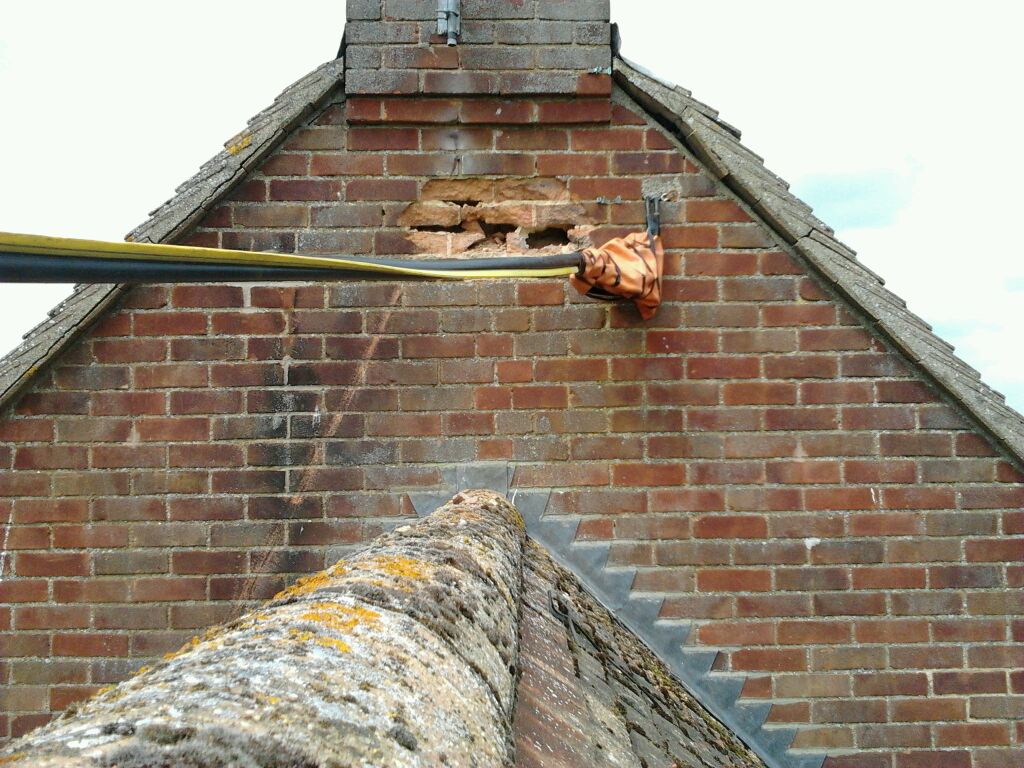
Lightning Strike On Aerial Installation in Woolpit near Stowmarket Suffolk.

The power of nature never fails to amaze me. These pictures were from a call I had the other week after the storms we had in Suffolk. Apart from the obvious hole in chimney, notice how the roof has lifted also. As well as me the telephone man and electrician were calling at the same time to assess and put right other damage caused.

I forgot to take a photo of the aerial and coax cable but suffice to say it was not looking good.


Aerial View

Friday, 2 August 2013

Sky's new WiFi enabled Set Top Box ready for September


Sky is set to upgrade its Sky+ HD box with built-in Wi-Fi for the first time.

New customers will get the latest box without the need for an Ethernet cable to access on-demand content from September.
"This will ensure every new customer will be connected automatically, and we'll also roll out this box selectively to existing customers who don't yet have an HD box," Sky's Jeremy Darroch explained.

The company intends to push its wireless connector device to existing HD customers, but it is unclear if it will be free or charged at the current price of £21.95.

Sky recently announced a new set-top box for its Now TV service, costing £10.

The device provides access to films and Sky Sports events to rent, as well as the BBC iPlayer, Demand 5, Spotify and Facebook.


Source:

http://www.digitalspy.co.uk/tech/news/a501711/sky-hd-box-to-get-built-in-wi-fi-upgrade-in-september.html

Now TV set-top box, Smart TV tech for £9.99


Sky has launched a Now TV set-top box capable of streaming things like iPlayer, Spotify and Demand 5.

The box, which costs just £9.99 including shipping, is aimed at transforming your television set into a smart TV. It rivals devices like the Apple TV and the recently-announced Google Chromecast dongle.

BSkyB began investing in Roku last year. The company is known for its set-top box offerings, with the Roku 2 XS being particularly well received. The Now TV box appears to be a rebranded version of this device, with Now TV software.

Those who invest will get access to Now TV, iPlayer, Demand 5, Spotify, Facebook and Sky channels like Sky News. Now TV allows you to rent movies on demand as well as view Sky Sports coverage.

The Now TV set-top box can be picked up from NowTV.com today.


Source:

Film 4 (+1) returns to Freeview


From the 27th of August, Film 4 (+1) returns to freeview! The +1 channel allows viewers to catch a film an hour later which helps with viewing and recording scheduling.


Customer out of reach of the main aerial transmitters e.g Sudbury, Talconeston Sandy and Crystal Palace, and therefore receiving signals from a relay transmitter  know that Film 4 has not been included in the channel line-up since the start of HD broadcasts. This changes from the start of August, when the main Film 4 stays on channel fifteen but moves broadcast frequency to become available from relay transmitters.
A simple retune of your freeview equipment will bring this channel to you.
(Those of us on main transmitters such as Sudbury, will still need to retune to accommodate the change but Film 4 remains on channel 15)

Call me if you need any help or advice with retuning.

Kevin
Aerial View 01787 311057 
www.aerial-installers.co.uk
aerial-view@aerial-installers.co.uk

Saturday, 13 July 2013

Romanian TV Satellite Installation in Sudbury Suffolk

Start the day with a Satellite installation in Sudbury Suffolk. This was not a Sky installer job but an installation for a Romanian TV. Installed and checked signal was OK. My customer subscribes to the Dolce TV package 
Dish aligned to Hellas Sat 2 at 39 East, just under Sky Dish.
on the Hellas Sat 2 at 39 East and he was able to confirm all his programmes were coming through strong. Apart from Romanian TV other jobs I have for this satellite are  Bulgerian TV and Serbian TV. Peculiarly, there are not many Greek channels on Hellas Sat. In fact I'm only aware of Riksat a Cypriot channel and Sport Plus in the Bulsat package, but no more. 

TV Distribution in Halstead Essex.

This was a recall to a job completed the other week. Customer had called stating that the Sky signal was OK through the distribution system that I had installed during a refurbishment, but the Freeview signal was breaking up.


It was a simple solution. After I had finshed the work and had  left my customer had to move the main TV and boxes in the lounge in order to have new carpets fitted. On reconnection the aerial feed and the return to the loft for signal distribution around the house had got swapped over. Simple 30 second job if you know what you are looking at! Two down and still only 10.30.

Sky Repair in White Colne Essex.

Next job was only ten minutes down the road. My customer had already suspected a tree problem as to why his satellite reception was poor, and he was right. His house was listed and so dish could not be mounted on the house and had to be ground mounted on a patio mount. There was no alternative site, so I had to raise the dish by a couple of feet to clear the top of the tree. My customer is aware that the problem may reoccur in a few years.

Next stop was home for an early lunch or if you prefer a late brunch, before moving on to Bury St Edmunds.

Sky Installation in Barrow near Bury St Edmunds Suffolk.

Actually this was an installation of a new Sky HD box that Sky had supplied my customer with.


My customer also wanted to clear out all of the ‘rubbish’ under his TV (unused VCR's etc.) . So out with it all and in with the shiny new Sky box. Pair my customers Sky card up with his new Sky HD box and program the Sky remote control to operate his Panasonic TV and all done, nearly. He wanted two old aerials removed from each end of his house. First one removed with no incident.
 Next one, ouch, so this is why they say you must wear a hard hat. It’s for when the rusty v bolt snaps and the pole comes down and smacks you in the head.  I can tell you it still hurts even if there is no sense there!


Tuesday, 9 July 2013


Freesat repair in Chevington Suffolk:


First job today was in the grounds of Ickworth Park near Bury St Edmunds. The property is at the Chevington end of the grounds where there are masses of trees. This was a Freesat problem, but the trees were not the problem. I don’t think Freeview via a TV aerial would have been very good here as there are trees at nearly 360 degrees around the property. There is one direction where the trees are not quite so high and that is in the direction of 28.2 east of south, the location of the Sky and Freesat satellite.   
The customer had a Freesat+ system and a standard Freesat box. The problem was one feed was not working. On investigation I found a join that was water damaged with corroded connections. Simple solution was to replace cable and after doing so all was well.
I passed a few minutes chatting with customer whilst I finished my tea and then decided to leave via the Horringer exit of the estate.

Sky Box Repairs
This job was fairly quick so had a bit of time to kill.  Decided to return back to the office and repair a couple of Sky boxes that I had swapped out over the previous week.  After fixing these and having some lunch I moved on to my next call in Belchamp Walter for an aerial installation.

TV Aerial Installation in Belchamp Walter Suffolk:

 The customer had been using an amplified set top aerial with a little bit of success but not very reliable. Again there were trees in the vicinity, but nowhere nearly as dense as the job from this morning. As the property was 17th century the customer was keen to not have an external aerial. Up in the roof space, I confirmed the signal quality and strength were fine and agreed to install the aerial in the roof space. In fact I had to fit an attenuator to reduce the signal down by about 15dB.  After completing this I returned TV and checked all was looking good. Customer was cock a hoop with the final result.

Back home and restock van and check jobs booked for tomorrow. It is mainly aerial calls in and around Sudbury. Now to go and enjoy the sunshine that has finally arrived this year.


Aerial View 01787 311057

Thursday, 13 June 2013

CAI Distance Learning Course – SMATV and IRS Networks
City and Guilds Course 3456-1

One of my customers told me a while ago that one of my competitors in the aerial and satellite installation business in Suffolk (he will rename nameless) told him that there was no such thing as a City and Guild qualification in the aerial and satellite industry. As I  advertise the fact that I have this qualification and gained a distinction in the course, I thought I’d post this for my more ‘inquisitive’ customers who may be sad enough to wonder “What is the SMATV and IRS Networks course?"

Well first to explain the different acronyms: 

MATV – Master Antenna TeleVision.

In other words one aerial delivering just terrestrial based signals to a multitude of points via a network, possibly in a block of flats or even a housing estate. Many CATV (Cable networks) are in fact very large MATV systems. 

SMATV – Satellite Master Antenna TeleVision.
As above, but with the addition of selected locally modulated signals, usually from satellite but could be from DTT or video recorders etc. This is the type of system normally associated with hotels etc., but could even be a CATV.

IRS – Integrated Reception System.

This is now the preferred method to deliver signals in multiple dwelling units. It gives subscribers access to all terrestrial and satellite signals as if they were connected to their own dish and aerial. The headend (all the electronics etc) is totally transparent to the consumer. 

Synopsis of course.

The course consists of ten units spread over a six-month period. Attached to each unit is a tutor marked assignment (TMA). At the end of the course, there is an exam to sit. I had to do some practical assessments at the CAI offices. It is a condition of the course that before you can take the final exam that you have obtained a minimum mark of 50% in your TMAs and have completed the practical days.
Many of my fellow students on my course never reached this far; in fact most of the employees form a large national company had dropped out long before this stage! Although you have to pass the TMAs and practicals, the final mark is purely on the exam result.

The practical assessments are generally based around making and recording measurements in different scenarios that you have to set up. The assessments not only check that you are capable of doing the work, but they also compliment what is learned in your coursework. One of the practical assessments involves designing a small system to take all off-air UHF channels and four locally modulated channels and planning the system to deliver adequate signals for all channels to multiple outlets.

Although the course is about systems design and build, much of the work involves the reasons behind why things are done rather than ‘This is how to do it’. Quite a large proportion involves the use of mathematical formulae and this is where most of the failures drop out.
CAI training programme is structured for people to follow through the courses consecutively with the distance-learning course being the most advanced. The CAI state this is not an easy course! I’d agree, but I did not find it particularly taxing either.

The ten units of study are:


·         Unit 1 Propagation of Radio Waves
·         Unit 2 Cables & Transmission Lines
·         Unit 3 Signal Generation & Broadcasting, including digital broadcasting
·         Unit 4 Principles of Aerials
·         Unit 5 Test Equipment, including the latest test methods
·         Unit 6 Satellite Reception, including digital
·         Unit 7 IRS Networks, including 5 and 9 wire
·         Unit 8 Choice of Antenna, Installation and Maintenance, including benchmarking
·         Unit 9 Signal Combining and Splitting
·         Unit 10 SMATV Networks, including digital reception


Friday, 31 May 2013

BBC have made some changes to Red Button on Freeview yesterday

Things have changed on the terrestrial BBC Red Button service.
There will now be HD content on 303, some name changes, a bit of shuffling around and an extra channel..


Go to channel 302. if you see a message that says "If you can see this message on 302, then you need to re-tune " Well it's pretty obvious what you need to do eh?


Here is a summary of what has changed:

  • The Red Button channel on '301' is now called BBC RB 301
  • The Red Button channel on 302 has moved to 308 
  • A new Red Button Channel is on 302 called RB 302 
  • The Red Button on 303 is now RB 303 HD

If you have any problems with re tuning then give me a call or email. 


    Friday, 17 May 2013

    Brighton 4G Test Progress

    The 4G trial has been in progress in Brighton for a week now and apparently no significant interference. This is interesting for us in Suffolk as their main transmitter carries a multiplex that transmits on Ch60 just like the Sudbury transmitter does. So, I wont be stock piling 4g filters just yet :-) More at @https://plus.google.com/102455228993633126453/posts